Warm morning light across a quiet wooden studio floor

Gothenburg · Sweden

Tantric Pulsation Breathwork

Breath, body, energy and awareness – a deep exploration through Tantric Pulsation.

Explore Tantric Pulsation through our six-part Breathwork Training in Gothenburg, starting every September and continuing through the winter season into spring.

Annual six-module training in Gothenburg · September–April

The method

What is Tantric Pulsation?

Tantric Pulsation is an embodied approach that combines conscious breathing, body awareness, movement, emotional exploration, energy work, meditation, dearmouring and elements of Tantra.

Rather than trying to understand everything intellectually, much of the exploration happens through direct experience of the body. You are not asked to believe anything in advance — you are invited to notice what actually happens when you breathe, move, rest and pay attention.

The breath is used as one of the central tools for increasing awareness of sensations, feelings, energy and patterns held in the body. Some of these patterns are subtle and easy to overlook in everyday life; slowing down and turning attention inward often makes them more noticeable.

The approach invites participants to become more present with what is already happening inside them, rather than trying to force a particular experience. Depending on the practice, the work can be quiet and subtle or more energetic and expressive.

  • Conscious breathing
  • Body awareness
  • Movement
  • Emotional exploration
  • Energy
  • Meditation
  • Dearmouring
  • Tantra

The body as an entry point

From thinking to feeling

Much of everyday life happens through thinking, analysing and interpreting. We explain ourselves to ourselves. Tantric Pulsation invites a different kind of attention — one that begins in the body and stays there a little longer than usual.

  • Physical sensations
  • Breathing
  • Impulses
  • Movement
  • Emotions
  • Tension and relaxation
  • Boundaries
  • Energy
  • Connection
  • Presence

By directing attention toward the body, participants may become more aware of habitual patterns that are difficult to notice through thinking alone — how we hold our breath, brace, withdraw or push. This is exploration and self-study, not diagnosis or treatment.

The role of the breath

Breath as a bridge to the body

Conscious breathing is central to Tantric Pulsation. Different breathing patterns can create different experiences. Some practices are slow and calming. Others are deeper, fuller or more energetic and may increase bodily sensations, emotional awareness and the subjective experience of energy.

A direct line of exploration

breathbodyfeelingsawareness

Breathing can influence our state, which makes it a practical way of exploring how these layers relate to each other. The intention is not simply to “breathe harder”, but to develop sensitivity to what happens inside the body while breathing.

Participants learn to listen to the body and adapt intensity rather than forcing themselves through an experience. Slowing down, pausing or softening is always a valid choice.

The name

Why “Pulsation”?

The body naturally moves between different states. Nothing alive stays in one fixed condition for very long.

  • Expansion and contraction
  • Activation and relaxation
  • Expression and stillness
  • Giving and receiving
  • Movement and rest

Tantric Pulsation explores this natural movement rather than seeking one constant state. Breath, body and energy can be experienced as having a rhythm or pulsation — sometimes flowing easily, sometimes not.

The practice invites participants to notice where movement feels free and where they may habitually hold, contract or control. This is described as it is experienced, rather than as a claim about established medical physiology.

Dearmouring

What is dearmouring?

In this context, armouring refers to habitual patterns of muscular holding, protection or tension in the body. These patterns often develop for good reasons, and they can become so familiar that we barely notice them.

Dearmouring practices invite greater awareness into these areas through combinations of:

  • Breath
  • Attention
  • Movement
  • Sound
  • Conscious touch
  • Relaxation
  • Emotional awareness
  • Presence

The intention is not to force tension to disappear. Instead, participants explore whether the body can gradually become more aware, responsive and relaxed — often in small steps rather than dramatic ones.

All touch-based practices involve consent, clear boundaries and participant choice. Dearmouring is an experiential practice; it is not presented as a way to remove trauma or cure medical conditions.

Emotions and expression

Making space for feelings

Many of us learn early on to control or suppress emotional expression. Within Tantric Pulsation, participants are invited to notice feelings through their bodily experience — where a feeling lives, how it moves, what it does to the breath.

  • Joy
  • Sadness
  • Anger
  • Fear
  • Tenderness
  • Vulnerability
  • Pleasure
  • Excitement
  • Stillness

The emphasis is on allowing awareness and expression without needing to judge or analyse every feeling. There is no requirement to have dramatic emotional experiences. Subtle experiences are equally valid, and a quiet session is not a failed one.

Energy

Exploring energy through the body

Energy is an important part of Tantric Pulsation. Here, “energy” is used primarily as an experiential term — a way of describing what people notice, not a scientific measurement.

  • Warmth
  • Tingling
  • Vibration
  • Movement
  • Expansion
  • Aliveness
  • Stillness
  • Increased sensitivity
  • Waves of sensation through the body

Tantric Pulsation explores how breath, movement, attention and relaxation can affect these experiences. The training also works experientially with traditional concepts such as energy centres or chakras. These are presented as part of the Tantric framework and as a map for exploration, rather than as established medical anatomy.

Tantra

What does Tantra mean in this training?

Tantra within Tantric Pulsation is much broader than sexuality.

Many people first meet the word Tantra in a sexual context. In this training, Tantra is approached as a way of relating to life through presence and embodiment. The training explores it through:

  • Presence
  • Embodiment
  • Meditation
  • Awareness
  • Connection
  • Sensitivity
  • Energy
  • Authentic relating
  • Conscious touch
  • Acceptance of the body
  • Intimacy
  • Sexual energy

Sexual energy is one aspect of the training, but it is not the entire method. The emphasis is on developing greater awareness and presence rather than achieving a particular sexual experience.

Sexual energy

Sexual energy as life energy

Tantric Pulsation includes exploration of sexual energy as one aspect of human vitality and embodied experience. The approach is quiet, respectful and grounded — closer to meditation than to performance.

  • Sensing energy without immediately acting on it
  • Breathing while remaining present with sensation
  • Relaxation rather than performance
  • Boundaries
  • Sensitivity
  • Receiving
  • Connection
  • Presence in intimacy

Exercises in this area are always optional, framed clearly beforehand, and carried out with the same consent culture that runs through the whole training.

Ethics of the work

Conscious touch, boundaries and consent

Some exercises involve working with another person and conscious touch. How this is done matters as much as what is done, so consent is practised explicitly rather than assumed.

  • Clear consent
  • The right to say yes or no
  • The right to change one's mind
  • Communication
  • Sensitivity
  • Non-intrusive touch
  • Awareness of one's own boundaries
  • Awareness of another person's boundaries
  • Personal responsibility

No participant is ever expected to take part in a particular touch exercise against their wishes. Choosing to observe, to adapt an exercise, or to rest is always available and is treated as a legitimate part of the practice.

Presence

Learning to stay present with another person

As the training progresses, participants explore not only their own processes but also how to be present with someone else while they are in theirs.

  • Listening
  • Observing
  • Staying grounded
  • Not rushing to fix
  • Respecting boundaries
  • Noticing one's own reactions
  • Using intuition responsibly
  • Supporting rather than controlling another person's process

This is particularly relevant for participants interested in eventually facilitating breathwork, and it is also simply useful in friendship, partnership and everyday life.

In practice

What a Tantric Pulsation session can include

A session or exercise may contain different combinations of the following elements:

  • Conscious breathing
  • Body awareness
  • Movement
  • Grounding
  • Meditation
  • Music
  • Sound or vocal expression
  • Emotional exploration
  • Partner exercises
  • Conscious touch
  • Dearmouring
  • Energy awareness
  • Periods of activation
  • Periods of stillness and integration

Not every session contains all of these. The exact experience varies depending on the exercise, the module and the participant.

The training

Learn Tantric Pulsation through experience

The Tantric Pulsation Breathwork Training is an annual six-part training held in Gothenburg, Sweden.

A new Tantric Pulsation Breathwork Training starts every September in Gothenburg.

Each cycle continues through the autumn and winter season into spring, normally finishing around April. The six modules are weekends, spaced so that there is time to live with what each one opens up before the next one begins.

I'm interested – tell me more

No commitment – we'll send you more information.

I want to register

Book the full training or single modules.

Current training cycle

September 2026 – April 2027

These are the dates for the current cycle. The structure repeats each year with new dates. Each module is standalone, so you can join at any module during the year, depending on availability, and attend one or several modules. If you miss a module you can normally take it during the next year's cycle.

  1. Module 1

    Grounding

    26–27 September 2026

  2. Module 2

    Trust & Intuition

    24–25 October 2026

  3. Module 3

    Connection & Embodiment

    5–6 December 2026

  4. Module 4

    Inner Child

    30–31 January 2027

  5. Module 5

    Sexual Energy

    27–28 February 2027

  6. Module 6

    Meditation

    3–4 April 2027

Flexibility

Join any module, one year or several

You can join the training at any module during the year and choose how far you want to go.

Each module stands on its own, so you are welcome to attend a single weekend, a few modules, or the complete six-module training. There is no requirement to start with Module 1.

Because the training repeats every year, you can also spread the full journey across different years. If you miss a module or want to take the training slowly, you can normally complete that module during the following year's cycle.

After completing all six modules, participants receive a diploma.

Rhythm of the year

A journey through autumn and winter

The training begins every September and continues through autumn and winter into spring. Meeting repeatedly over approximately seven months gives the work time to settle.

  • Experience each module
  • Integrate between weekends
  • Observe what changes in everyday life
  • Return to the group
  • Deepen the exploration gradually
  • Build trust within the group

The journey itself is part of the training. What happens between the weekends — in ordinary days, relationships and work — is often where the most interesting material appears.

Across six modules

What we cover throughout the training

  • Presence with body and breath
  • Grounding
  • Body awareness
  • Feelings and emotional expression
  • Trust
  • Intuition
  • Connection
  • Embodiment
  • Personal boundaries
  • Consent
  • Old protective patterns
  • Dearmouring
  • Authentic sharing
  • Vulnerability
  • Energy awareness
  • Energy centres
  • Conscious touch
  • Sensitivity
  • Intimacy
  • Sexual energy
  • Meditation
  • Relaxation
  • Giving and receiving sessions
  • Holding space
  • Supporting another person's process
  • Developing responsibility as a facilitator

Two pathways

Personal development or facilitation

For your own journey

The training can be taken entirely for personal exploration and development. You do not need any intention of becoming a facilitator. Many participants come simply because they want to know their own body, breath and patterns better.

For those who want to facilitate others

The training also serves as preparation for people who want experience in:

  • Facilitating breathwork
  • Giving and receiving sessions
  • Holding space
  • Conscious touch
  • Boundaries
  • Presence
  • Supporting another person's process

The diploma confirms completion of this training. It is not a government-authorized or medically regulated professional qualification.

The group and teaching format

Three teachers – supported by a team

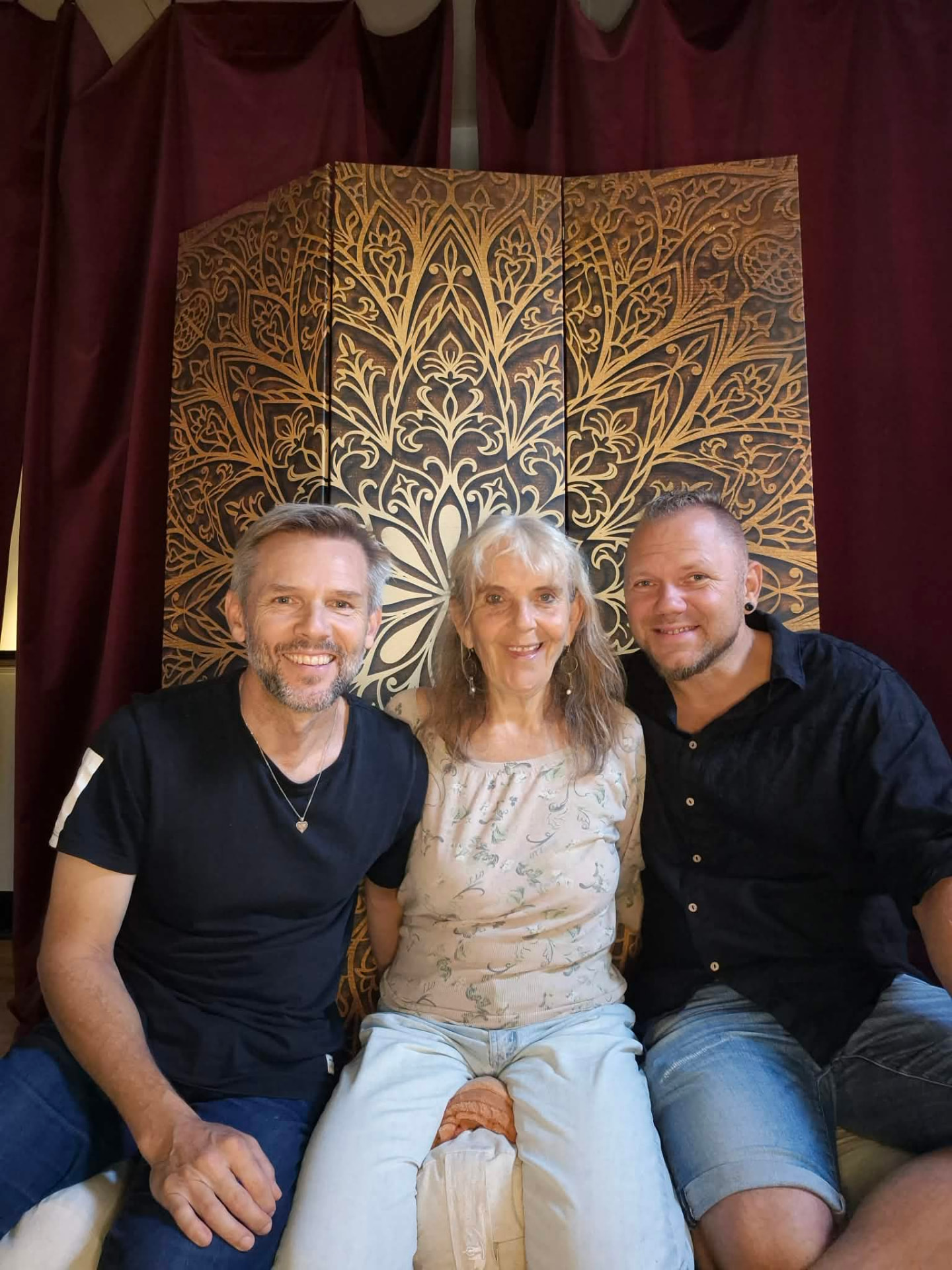
One distinctive quality of this training is that it is not held by one teacher alone. The main teaching team consists of Smrati Skog, Jarno Kinnunen and Peter Forsberg, supported by a number of trusted assistants.

  • Different perspectives
  • Different areas of experience
  • More individual support
  • Greater presence within the group
  • A more carefully held training environment

The aim is a supportive, grounded and safety-conscious environment where people can move at their own pace.

Smrati Skog

Founder of Tantric Pulsation Breathwork Training

Smrati is one of Sweden's most experienced Tantra teachers and has been exploring and teaching Tantra for more than 30 years. She has spent many years in India and Europe immersed in Tantra, meditation and personal development, and brings extensive experience, intuition, vitality and depth to the training.

Jarno Kinnunen

Breathwork & Tantra facilitator

Jarno came to this work through a different path. After many years as an entrepreneur in the roofing industry, his own journey led him increasingly into personal development, breathwork and Tantra. Today he facilitates workshops in breathwork and Tantra, combining strong energy and intuitive guidance with grounded presence, with a particular interest in energetic breathwork and the relationship between breath, body and energy.

Peter Forsberg

Bodyworker & dearmouring facilitator

Peter is an experienced bodyworker and facilitator working with somatic coaching, body-based personal development and dearmouring. He has been engaged in personal development for approximately 15 years and facilitates workshops and retreats in breathwork, Tantra and dearmouring. His approach is characterized by a soft, grounded and stable presence.

Course material

Material to support your integration

Participants completing the training receive course material and a compendium that supports the modules and their own notes and integration between weekends.

Inspiration for the work includes writings within Tantra and body-oriented personal development, including authors such as Aneesha Dillon and Diana Richardson.

Investment

Price and booking

Price per module

Regular price
3 700 SEK
Companies
3 700 SEK ex. VAT
Booking fee
600 SEK

The booking fee is deducted from the total amount but is non-refundable. Early Bird pricing for the current cycle closed on 10 August 2026. A new Early Bird period opens for the next cycle.

Full training

When the complete six-module training is booked and paid in advance:

Private individual
16 500 SEK incl. VAT
Company
16 500 SEK ex. VAT

Practical information

Gothenburg, Sweden

The training takes place in central Gothenburg. Each module is a weekend, and the current general schedule is:

Saturday

10:00 – 20:00

Starts at 10:00, ends no later than 20:00

Sunday

09:00 – 19:00

Starts at 09:00, ends no later than 19:00

Exact venue and timing details are confirmed for each module ahead of the weekend and may be adjusted.

Voices

What former participants say

Listen to reflections from people who have taken the training.

Questions

Frequently asked questions

Ready to explore Tantric Pulsation?

A new training starts every September in Gothenburg.

To ask questions or reserve a place, write to us — we are happy to talk about whether the training fits where you are right now.

I'm interested – tell me more

No commitment – we'll send you more information.

I want to register

Book the full training or single modules.

Contact JarnoContact SmratiContact Peter